The Park is Gone – Jurassic World: Fallen Kingdom SPOILER Review
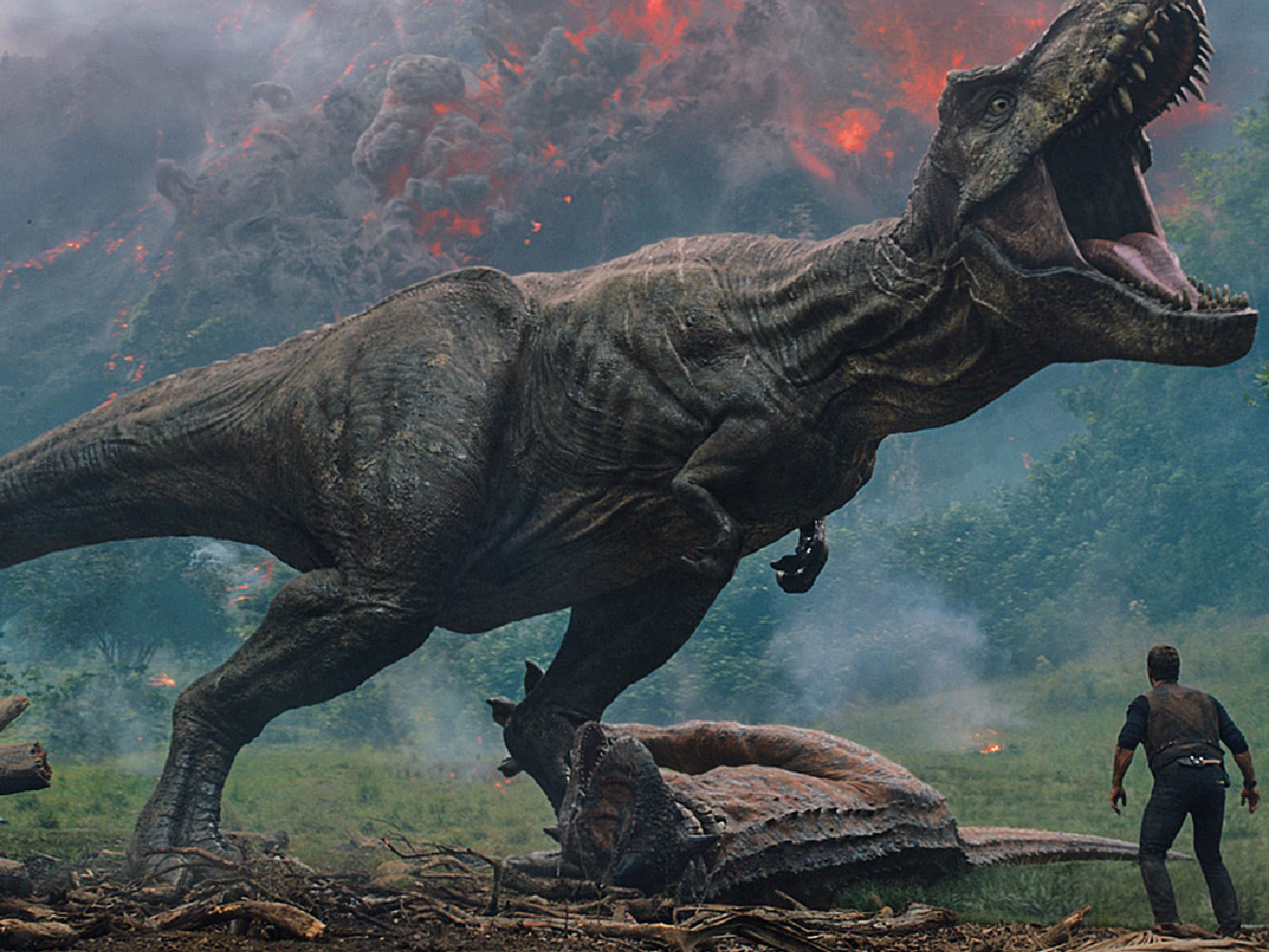
Jurassic World: Fallen Kingdom continues the story in this cycle of Jurassic films three years after the events in Jurassic World. The park is abandoned and the island is overrun by dinosaurs. But when a cataclysmic volcanic eruption threatens the existence of these theme park attractions, our heroes once again find themselves on Isla Nublar. This time to save the very animals they were running away from in the previous instalment. Director JA Bayona’s effort is one of the most thrilling and entertaining entries in this series. Even if you are not completely on board with the interesting turn this film marks for the series, you are guaranteed to walk away feeling that you’ve had a great time.
The Park is Gone
Jurassic World: Fallen Kingdom makes a bold move in destroying everything that has come before. By the 52-minute mark, the park and the island are quite literally gone. The first half of the film plays out as a rescue operation. Claire Dearing and her Dinosaur Protection Group make it their mission to fight for the rights of Jurassic World’s creations. Without any assistance from the US government, she finds a saviour in Sir Benjamin Lockwood, John Hammond’s original InGen partner.
With Lockwood’s funding, InGen launches a rescue operation to save 11 species from the volatile Isla Nublar, including the last living velociraptor Blue. Of course, Blue would not be easy to capture. So Claire manages to convince Owen Grady to help rescue the creature he spent so much time training.
It is wonderful to see the park in its state of natural decay. In a way, that is exactly what fans of the original Jurassic Parkalways wanted – to return to Isla Nublar after the events of the first movie. Instead, for the first two sequels, we were taken to Isla Sorna, Site B, and must admit that we felt cheated. So, well done.
When Owen manages to track down and capture Blue, the film takes a darker twist. We learn that — surprise — InGen has no plans to move the captured dinosaurs to a new location, but rather to sell them off to the highest bidder.
A Daring Escape
This revelation kicks off a thrilling escape sequence where our heroes and the dinosaurs do their best to escape the crumbling island. Claire and co obviously manage to sneak onto the departing InGen ship on time, but most of the dinosaurs are not so lucky. There is a heartbreaking scene where the ship leaves the island behind. We see a lone Brachiosaurus standing on the pier, calling for help before being enveloped in ash and flame. This scene is quite significant as the Brachiosaurus was the first dinosaur we saw in Jurassic Park’s most iconic scene. The demise of this helpless behemoth signals a thematic shift for the series and severs all ties to what has come before.
A Whole New World
But the film does not end with the destruction of Isla Nublar. We’re only halfway. The real darkness comes when the captured dinosaurs reach Lockwood Estate in northern California. It is here that the film shifts tone from a thrilling disaster story to a more claustrophobic, nearly gothic horror film.
Rafe Spall’s shrewd Eli Mills holds an auction, selling the newly acquired assets to corporates and warmongers without discretion. We also learn that he is working closely with Dr Henry Wu, the brains behind InGen’s genetically engineered monsters. And Wu has not been resting on his laurels. Since escaping the island when his last creation, the Indominus Rex, wreaked havoc in the park, Wu has been back in the lab and concocted the next stage in genetically-engineered dino evolution: the Indoraptor. More intelligent and more deadly than the I-rex ever was, the Indoraptor quickly escapes its confines and stalks the mansion like a ghost out of the best gothic horror stories. Wu obviously never learns.
The Youngest Lockwood
Much of the second half of this film focuses on Maisie, Lockwood’s 10-year-old granddaughter. When we learn that she is not actually Lockwood’s granddaughter, but a clone of his own daughter, the power inherent in cloning dinosaurs takes on a less wondrous and more menacing tinge.
While the film concerned itself with questions as to the rights these animals have to exist, when you slap a pretty 10-year-old face on it, the situation gets more sticky. Maisie realises that she is no different to Lockwood’s dinosaurs, and as a person who enjoys a specific set of rights just for existing, she sets the dinosaurs free to roam the mainland in an ending that sends a clear message: the magic of a dinosaur theme park has forever changed the future of our world.
Welcome to Jurassic World
We finally see some method in the name change implemented in the last film. It works quite well to set this trilogy apart from the original. Ian Malcolm’s closing narration makes it clear that the Jurassic universe is entering its next evolutionary stage, one in which humans and dinosaurs will have to learn to coexist. This recalls Dr Alan Grant’s statement in the first film, warning that we have no idea what to expect when two species separated by 65 million years of evolution are suddenly thrown back in the mix together. This sets the scene for what promises to be an interesting conclusion when the third instalment hits screens in 2021.
The Sayles Script
A few years ago I managed to get my hands on the unproduced Jurassic Park 4 script by John Sayles. This script starts with a mercenary retrieving Dennis Nedry’s lost Barbasol can from Isla Nublar. These embryos are then used to weaponise dinosaurs by splicing human and dino DNA.
I remember thinking how much I would hate it if this became part of the Jurassic Park canon. In watching Jurassic World: Fallen Kingdom, I couldn’t help but feel some echoes of that script. That said, the way the new film uses its ideas as a basis has me intrigued.
Jurassic World of Horror
In many ways, Jurassic World: Fallen Kingdom improves on 2015’s Jurassic World. And much of that is owed to director JA Bayona and his distinct vision. Best known for his tight ghost story The Orphanage, he moves the film along at a brisk and intense pace.
The opening scene with the Mosasaurus and T-Rex sets the pace and the film never pauses to catch a breath. Bayona masterfully handles the huge explosions of the volcanic eruption. He then successfully switches gears to the tight and claustrophobic haunted-mansion sensibility in the second half.
The look of this film is fantastic. We finally get the blend of practical effects and CGI that we were promised but never got in Jurassic World. The animatronic Tyrannosaurus and Blue are standout sequences where CGI is used only to enhance what was done practically. It adds a real sense of tangibility to these creatures that we haven’t had for quite some time.
Michael Giacchino’s score is also magnificent. While we still get the rearranged John Williams theme, gothic choirs add depth to a film that could easily have degenerated into B-movie genre tropes, much like The Lost World: Jurassic Park and Jurassic Park III.
Final Thoughts
Jurassic World: Fallen Kingdom could easily have been a disappointment. It has happened before: The Lost World: Jurassic Park is the weakest entry in the series. While this sequel had to top Jurassic World, it is also the midpoint in a trilogy. These films normally suffer under the weight of setting up a conclusion we’ll only get to see in part three.
But the film is great. It manages to outshine Jurassic World in so many ways and offers a thrilling standalone tale to boot. It severs all ties with its past. Now we are set for a third instalment free from the shadows of Michael Crichton and Steven Spielberg.
Obviously, it’s not perfect, but that is not what we expect from this franchise. A good time is key and that the film delivers.
I highly recommend seeing this in IMAX. The huge spectacle deserves to be seen on the biggest screen possible.
 |  | Jurassic World: Fallen Kingdom Universal Pictures 2018 Starring: Chris Pratt, Bryce Dallas Howard, Rafe Spall Directed by: JA Bayona Written by: Colin Trevorrow, Derek Connolly |